
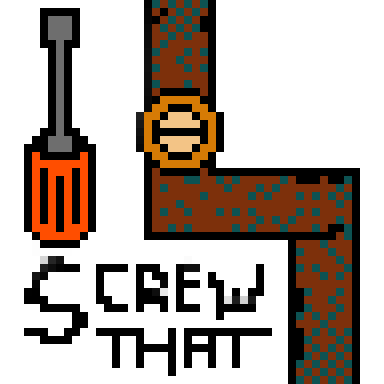
Screw That is a game that came together in under an hour in March 2025. A conversation between myself and Ben Kirman about how games can be a fertile medium for pushing past the traditional outcomes of a research project.
We were reflecting on domestic eco-feedback and energy reduction, a topic we both worked on a decade or so prior. If memory serves, I was frustrated by how intangible and distant the recommendations I made are from the lived experiences of energy consumers. I wanted to pull at what a game could be that was provocative, beautifully simple and so open that players experiences could wildly vary.
Here’s the notes from that March 2023 meeting.
SCREW THAT! A resource scarcity game
Screw driver valve - multiplayer - different player select valves on or off, other players confronted with isolated systems
- This is a game about resource scarcity based on possible futures where resources that we take for granted in everyday situations become suddenly scarce and we are faced with unfamiliar situations.
- SCREW THAT is a role playing game, that focuses on what many who have never struggled to source clean water may consider mundane, the domestic water supply.
- One of the aims of the game is to help people uncover, through discovery, prior knowledge, or experimentation, how water supply works in their home.
- What you need to play:
- A flat headed screw driver
- One or more willing players who you share a living space with
- Recommended extras:
- A bucket
- A length of hose
- A role of duct tape
- A funnel, or something that can be fashioned into a funnel
- Levels of scarcity
- Sources - where can you find water.
- Knowledge about water supply
- Ways water is used
- Map the valves?
- Examples of play:
- Player A turns off all supplies bar that to the washing machine and toilet. Players B and C construct a Jerry rigging mechanism involving hoses, breached warrenties, and mess the water from a source - toilet, washing machine, etc
- Play at home, multiplayer
- Game comes with one flat head screw driver, a hose, and some duct tape
- Liability form?
- Document in a journal what you do? Where you do it. Its impact. WhT you jerry rig
Version two in the series is with fuse box FLIP THAT! Another resource scarcity game
The game was a google doc with pixel art (by moi) before maturing into an 8 page zine which is available on itch.io.
Pixel Art
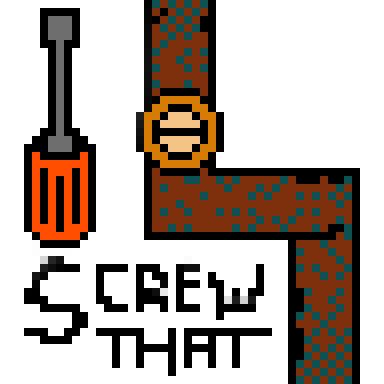

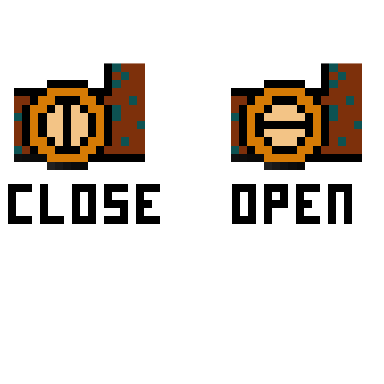
closed and open
Design notes
- unpolished - Screw That is low on details, has never been play tested, and does little to guide play. There’s no polish on the game, it is what is. It ends when it ends. The lack of polish leaves a lot of room for improvisation and interpretations.
- a quickly made game is a good game - It turns out I can make good things quickly given the conditions. It did help that I was looking for a distraction from work and Ben was showing up with creative energy after examining Alan Hook’s PhD “Imagining Otherwise. A Speculative Feminist Design Approach to Interspecies Kinship - a reflective account of other ways of knowing, thinking and being with and in the world.”.
- fun is not the purpose - And there’s no win state. I want players to role play resource scarcity as a way of sensitising themselves to the experiences of those around the globe who live with intermittent access to water and energy. What would you do if suddenly essential infrastructure ceased working in predictable ways?
- a moment in my life - A game like Screw That comes about because of where I’m at in various journeys. At work I’m frustrated by the norm being designing more technology to fix problems, layering more and more tech dependence and debt into our everyday lives. I am reflecting on how the work I’ve done speaks to these narratives. What does my work look like if I start asking questions like do home lives need to made more dependent on tech? Since our daughter was born I’ve been increasingly thinking about preparing as resilience to uncertain futures (climate or otherwise) and how I need to prepare to parent in uncertain times.
- doing and playing otherwise - The recent work and conversations (cf. Laurell Thorslund et al. 2025) about changing systems has left me wanting to try out different ways of thinking, being and doing - what better ways that through play, role play and games!
- turning speculation into stuff people can play with - Coming from a STEM and computing background it’s taken me a longtime to let my creativity lead the way. There’s a whole post about how I’ve come to get speculative design in recent years. Games have been a great material with which I can take speculative design and build spaces and experiences in which people can play with alternative ways of being, thinking and doing. By making Screw That I was able to get people to think about what if I couldn’t just google how to fix it, what if I HAD to fix it myself because help is inaccessible, would I experiment to fix infrastructure or would I connect with nearby people for help or to learn, and what do we do when we are left to work it out by ourselves. Part of me is curious to see how people might connect with neighbours when they can’t just google it.
Traces of Screw That
- May 2025 British DiGRA 2025 (Birmingham, UK) - Me and Ben presented our Research through Games Design pitch, mentioning Screw That. We handed out copies of Making a Meal out of a Mountain, a zine about research through games design
- November 2025 Gaming Social Justice (Imperial College, London, UK) - A green suitcase filled with Screw That mini zines and copies of Meal Deal followed Oliver and Ben to the event and were handed out.
- June 2026 DRS 2026 (Edinburgh, UK) - Screw That is mentioned in our paper talk on Research through Games Design
- June 2026 ICT4S 2026 Zine Library (Bern, Switzerland) - We submitted Screw That as part of the zine jam for ICT4S 2026
- Upcoming Mystery zine collection on Climate Change games